

By Ezra Ameis, DVM
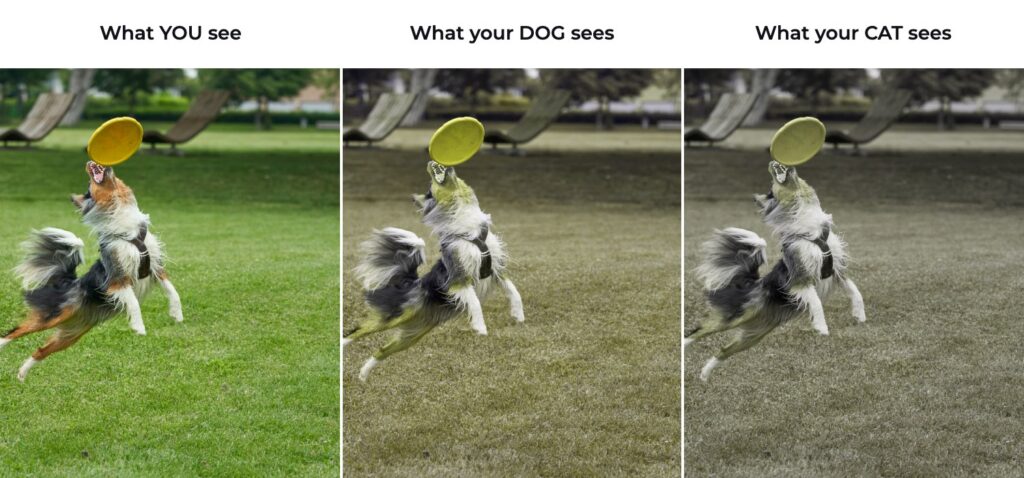
Ever wonder how your dog or cat sees the world? While many people assume pets are completely color blind, the truth is more nuanced. Understanding how their vision works offers insight into their behavior—and may explain why your dog can’t find that red ball in the grass.
🔴 Color Perception: A Muted, Blurry World
Photos by Afra Ramió, Anna Dudkova, Tatiana Rodriguez, and Wolfgang Hasselmann on Unsplash.
Humans have three types of cone cells in the retina—responsible for detecting red, green, and blue light. This trichromatic vision allows us to see a full range of vibrant colors.
Dogs and cats are dichromatic, meaning they have only two cone types, tuned to blue and yellow light. As a result, reds, oranges, and greens blend into dull yellows or grayish browns. Dogs tend to see more yellowish-green tones, while cats may perceive slightly more bluish hues, especially in low light. That bright red toy? Your dog likely sees it as a beige smudge in the grass.
Adding to the challenge, both species are mildly myopic (nearsighted). Dogs typically see with the clarity of about 20/75 to 20/100 vision, and cats are similar. What looks sharp to us may appear soft or blurry to them, especially at a distance. Despite these limitations, dogs and cats are remarkably skilled at detecting even subtle motion.
🌙 Night Vision: Ruling the Dark
Dogs and cats both have eyes adapted for low-light environments, thanks to a mirror-like structure behind the retina called the tapetum lucidum. This layer reflects incoming light back through the retina, enhancing night vision.

In light this dim, you would be guessing at shapes. A dog or cat already sees a scene they can move through.
Photo: Rosie Sun / Unsplash
That same tapetum is what causes your pet’s eyes to glow green in flash photography. By contrast, humans lack this layer—so our red-eye effect comes from light reflecting off blood vessels at the back of the eye.
Cats take it a step further. In addition to the tapetum, they have vertically slit-shaped pupils, which allow for more precise control of light intake. These features give cats night vision up to six times better than humans.
🎾 What This Means for You
If your dog loses track of a red toy or your cat seems indifferent to bright colors, they’re not ignoring you—they simply don’t see it like you do.
Opt for blue or yellow toys, use motion-based play, and appreciate the beautiful, instinctive way pets interact with their environment.
Their world may be less colorful—but it’s rich in movement, scent, and connection. And from where they sit, that’s more than enough.
See the world through your pet’s eyes
Try our live camera tool. Point your camera at anything around you and watch it shift, in real time, into how a dog or cat actually sees it.
Try the Pet Vision Camera →Dr. Ezra Ameis is an emergency veterinarian and the owner of Paw Priority in West Hollywood, a clinic providing general practice, urgent care, and acupuncture. To suggest a topic or ask a pet-related question, email hello@pp.vet.