

By Ezra Ameis, DVM
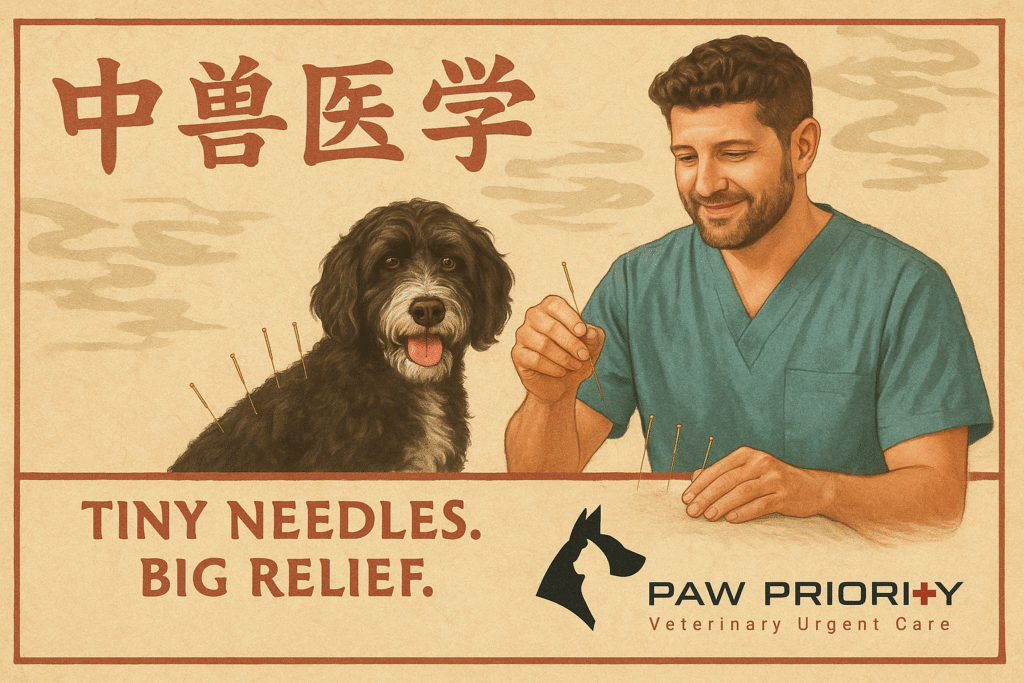
Mention acupuncture and most people think of humans—maybe a yoga instructor recovering from a muscle strain or someone seeking stress relief. But animals? Increasingly, yes. Veterinary acupuncture is no longer fringe medicine—it’s a rapidly growing part of modern veterinary medicine and an evidence-based tool we use to improve comfort, mobility, and recovery in pets. And it works.
Veterinary acupuncture involves inserting fine, sterile needles into specific points on the body—many of which align with nerve bundles, fascia planes, or vascular pathways. Each point is selected based on a detailed anatomical and neurological map. When stimulated, these points trigger local and systemic effects that help the body heal itself.
At the local level, acupuncture improves blood flow to the surrounding tissues. That matters—a lot. Better circulation brings oxygen and nutrients to injured areas, clears away metabolic waste, and supports tissue repair. It also promotes lymphatic drainage, helping reduce swelling.
But the effects aren’t just local. Acupuncture stimulates peripheral nerves, which in turn send signals up the spinal cord to the brain. This initiates complex biochemical cascades, including the release of endorphins, serotonin, and other neurotransmitters that reduce pain perception and enhance well-being.
One of the most fascinating mechanisms is something called "gate control theory." When you stimulate a nerve with acupuncture—especially the larger, non-pain (A-beta) fibers—you can actually override the transmission of pain signals from that area. It’s like distracting the nervous system with a competing signal that says: “Don’t worry about the pain—focus on this instead.” For chronic conditions like arthritis or spinal pain, this distraction can be powerful.
And recent research backs it up. A 2023 JAVMA study found that electroacupuncture at five key points significantly reduced postoperative nausea in dogs receiving morphine—offering results comparable to standard anti-nausea medications. Another large prospective study of 181 dogs with orthopedic and neurologic conditions showed acupuncture improved pain scores and mobility in nearly 80% of musculoskeletal cases, with significantly better outcomes for orthopedic pain compared to neurologic disease.
I practice acupuncture routinely for orthopedic pain, intervertebral disc disease, anxiety, nausea and a variety of conditions. I dont believe its an absolute Panacea for every problem. For some patients, it’s a primary therapy. For others, it complements western medical treatment. Importantly, it’s low-risk. There are no drug interactions. No sedation. Just the body nudged gently back toward balance.
The best part? Most animals accept it readily—dogs sigh and drift off, cats melt into a purr. On some level, they seem to know it helps. And for the pets we treat, each tiny needle is a gentle step toward comfort, healing, and a little more joy in the days ahead.
Dr. Ezra Ameis is an emergency veterinarian and the owner of Paw Priority in West Hollywood, a clinic providing general practice, urgent care, and acupuncture. To suggest a topic or ask a pet-related question, email hello@pp.vet.
Ready to try it
Book acupuncture at Paw Priority
If your pet has arthritis, anxiety, chronic pain, or is recovering from surgery, acupuncture pairs cleanly with the rest of their care. Sessions run about 45 minutes and most pets settle in within the first visit.
See the acupuncture page →