

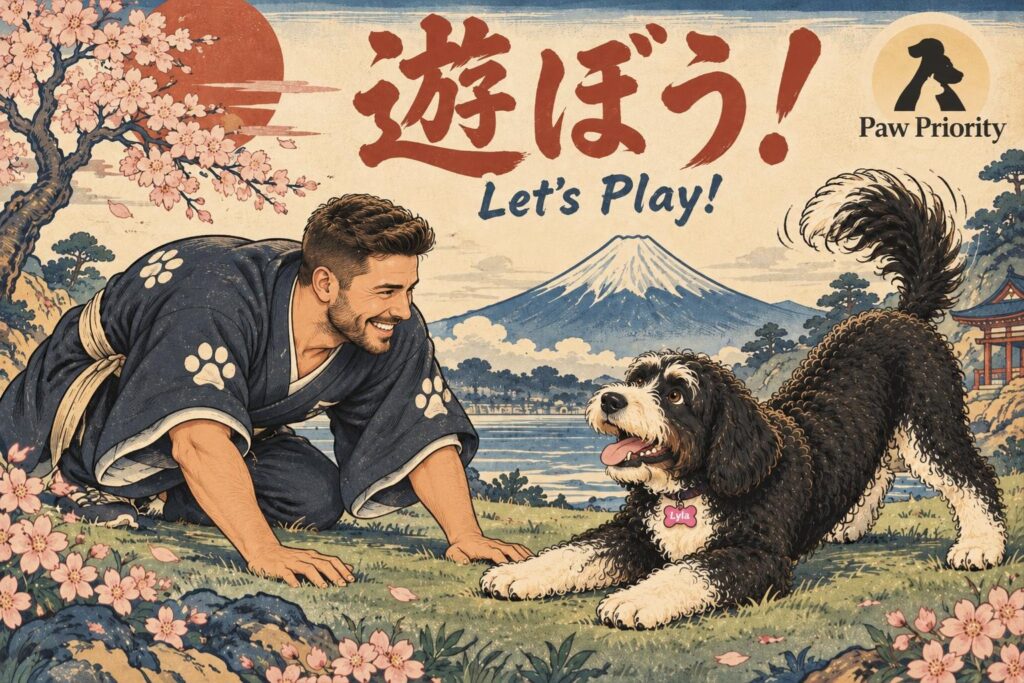
Front legs down. Rear end up. A brief pause, followed by an enthusiastic sideways leap.
You do not need a veterinary degree to recognize a dog asking someone to play. But that little bow is more interesting than it looks.
Researchers call it a play bow, and they have spent years studying where it fits into canine conversation. One useful finding is that it often helps restart the action. In a study published in 2016, dog puppies commonly bowed after a pause, and both puppies were more active afterward. The researchers also found that the bows were overwhelmingly performed where the other animal could see them.
That matters. A movement directed toward an attentive partner is different from a dog simply stretching its back.
The bow seems to be part of an exchange. One dog does something, the other responds, and the game continues. Researchers still debate its full meaning, so I would avoid translating every bow into one exact sentence. But “Ready for another round?” seems like a reasonable description of one common use.
There is another lovely detail in the research on play.
A 2015 study found that dogs sometimes copied a partner’s play bow or relaxed, open-mouth expression in less than a second. These rapid matching responses were more common between dogs with closer social relationships. Play sessions that included this mimicry also lasted longer than those containing the signals without mimicry.
The researchers suggested that this could help dogs share a playful mood. It does not prove that dogs experience amusement exactly as we do, but it offers a glimpse of how two animals can get caught up in the same activity.
That changes how I would watch a pair of dogs playing.
Rather than focusing only on the running and wrestling, look for the pauses. Who invites the next round? Does the other dog respond? Do they seem interested in continuing together?
You do not need to keep score or expect a perfectly equal exchange. The interesting part is noticing that the interaction has a rhythm.
From the park bench, two dogs may look like a blur of legs and questionable decisions. Slow the scene down, and there are little gestures worth paying attention to.
One dog lowers its chest. The other turns toward it. For a moment, they hold still.
Then they are off again.
Ezra Ameis, DVM
Paw Priority, Los Angeles